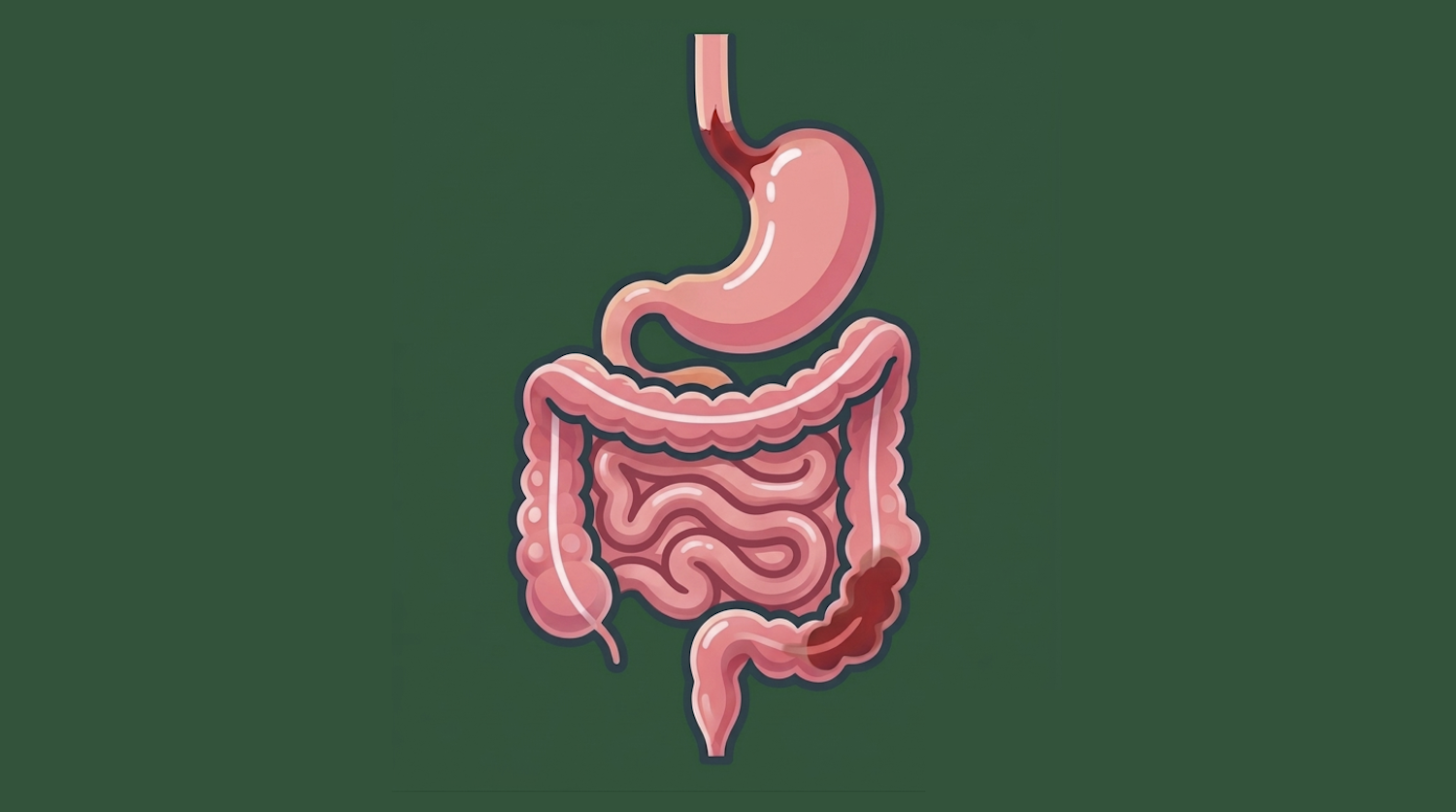
The term GI bleed is broad and refers to bleeding occurring anywhere from the mouth to anus. With many etiologies, the workup includes initial resuscitation followed by localization which uses upper endoscopy and colonoscopy. Endoscopy was invented by Philipp Bozzini around 1805-1806.
Etiology
- Upper GI bleed → most patients will have used aspirin or NSAID week before presentation; ask about history including cirrhosis and prior bleeding/ulcers
- Peptic ulcer disease
- Most common cause of upper GI bleed, ~50%
- Helicobacter pylori infection is most common cause of peptic ulcers
- Duodenal ulcer bleeding is more common than gastric ulcer
- Esophageal varices
- Associated with cirrhosis and portal hypertension
- Decreased production of clotting factors leads to potentially life-threatening bleeding
- Erosive disease
- Brisk bleeds = NSAIDs, alcohol, steroids
- Slower bleeds = H. pylori
- Mallory-Weiss tear
- Prolonged retching leading to partial thickness tear in mucosa at the GE junction
- Note: Boerhaave syndrome is full thickness
- Neoplasm
- Angiodysplasia
- Typically located in stomach fundus or body
- Uncommon
- Peptic ulcer disease
- Lower GI bleed
- Diverticular disease
- Painless brisk bright red per rectum
- More likely to bleed from right-sided disease
- Control with colonoscopy with clip placement +/- epinephrine injection and marking with Indian ink to help with locating during subsequent colonoscopy or surgery
- Anorectal conditions (e.g., hemorrhoids)
- Colonic polyps
- Colitis (e.g., IBD, ischemic, radiation, infectious)
- IBD (Crohn or ulcerative colitis)
- Crohn
- Involves GI tract from mouth to rectum
- Presents with abdominal pain and loose stools (rarely has bleeding)
- Ulcerative colitis:
- Continuous disease from rectum that can extent throughout entire colon
- Presents with frequent bowel movements with mucous-tinged BRBPR
- Crohn
- Ischemic
- Present with bloody, dark diarrhea and pain out of proportion
- Diagnosed with colonoscopy with biopsy
- Treatment is usually successful with nonoperative approach (bowel rest, antibiotics)
- Radiation
- May present with bloody diarrhea
- Colonoscopy shows friable ulcerating bloody mucosa
- Treatment
- Formalin
- Sucralfate enema
- Hyperbaric oxygen
- Infectious
- Etiology:
- Shigella (49%)
- Campylobacter (20%)
- Salmonella (19%)
- E. coli O157:H7 (8%)
- Clostridium difficile
- Presents with large-volume offensive diarrhea +/- bloody diarrhea with leukocytosis and lactic acidosis
- Treatment
- Toxic megacolon → emergent colectomy
- PO Vancomycin
- Etiology:
- IBD (Crohn or ulcerative colitis)
- Angiodysplasia
- Typically located in right colon, with cecum being most common
- Often seen in older patients >60 years, mitral valve disease, chronic renal failure
- Localized with colonoscopy with findings of stellate outline with bright red cherry mucosa and surrounding pale rim mucosa. If colonoscopy fails to identify, CTA can be performed which would show vascular ectasia with early emptying veins.
- Treat with argon plasma coagulation therapy
- Intussusception (consider in pediatrics)
- Unknown cause
- Diverticular disease
Presentation
- Hemoptysis
- Hematemesis
- Hematochezia
- Bright red blood per rectum (BRBPR)
- Hypotension
- Tachycardia
- Chronic anemia
Workup
- Resuscitation
- Labs: CBC, INR, PTT, BMP, lipase, LFTs
- CTA A/P
- Endoscopy → gold standard
- Colonoscopy
- EGD
- Small bowel evaluation
- CT enterography/MR enterography
- Tagged RBC scintigraphy
- Video capsule endoscopy
- Push endoscopy
- Intraoperative enteroscopy
- If all are negative, angiodysplasia is most likely cause
Management
- Resuscitation
- Localization of bleeding
- Upper GI
- 80% stop spontaneously
- EGD
- Complete within 24 hours
- Adjuncts: cautery, epinephrine, hemospray, clipping
- Esophageal tamponade
- Balloon tamponade may be option if variceal bleeding is uncontrolled despite medications and EGD adjuncts
- Options for temporizing bleed
- Sengstaken-Blakemore
- Minnesota tube
- Linton-Nacklas tube
- Endovascular
- Transcatheter-based angiographic intervention
- Diagnostic and therapeutic
- Surgery
- Localization must be completed before surgery
- Approach
- Bleeding gastric ulcers → excision
- Duodenal ulcer
- Expose pylorus and first part of duodenum
- Create anterior longitudinal duodenotomy through byporus
- Control gastroduodenal artery with three-vessel ligation
- Superior suture
- Inferior suture
- Horizontal mattress (“U” stitch for transverse pancreatic artery)
- Close pyloromyotomy with Heineke-Mikulicz pyloroplasty by closing the longitudinal opening in a transverse direction with single layer of sutures
- Incision closed with 3-0 seromuscular silk in transverse fashion, placing sutures first then tying
- Medications
- Octreotide: reduce risk of recurrent variceal bleeding
- PPI
- Lower GI
- EGD to rule out upper GI
- CTA
- Colonoscopy
- Performed after bowel preparation
- Should be completed within 24 hours
- Etiologies amenable to colonoscopy
- Diverticular disease
- Angiodysplasia → no-touch argon beam coagulation
- Postprocedural bleeding
- Lesion injected with India ink for future identification
- Endovascular techniques
- Patient must be hemodynamically stable
- CTA to localize lesion with contrast blush on scan
- Gel foam angioembolization
- Surgery
- Indications
- Hemodynamically unstable
- Transfusion >4 units of blood in 24 hours
- Transfusion >10 units during hospital stay (limited evidence)
- Have endoscopy tower in the room
- If unable to localize bleeding → subtotal colectomy with end ileostomy
- Rebleeding rate ~4% compared to 18% if segmental resection
- Damage-control can be applied in extremis patients
- Indications
- Upper GI
Relevant Information
- Categories
- Overt: clinically apparent
- Occult: not clinically visible to the patient
- Colon is most common location
- Workup should start with colonoscopy followed by EGD if colonoscopy is negative
- Obscure: clinical bleeding without clear location
- Workup should start with colonoscopy and EGD. If negative CTA can be used to localize the lesion
- Location
- Upper GI bleed: proximal to ligament of Treitz
- Lower GI bleed: distal to ligament of Treitz
Complications
- Most rebleeding occurs within first 3 days after endoscopic therapy
- Predictors of rebleeding
- Hemodynamic instability
- Comorbid illness
- Hemoglobin level upon presentation
- Active bleeding at time of endoscopy, ulcer size, ulcer location