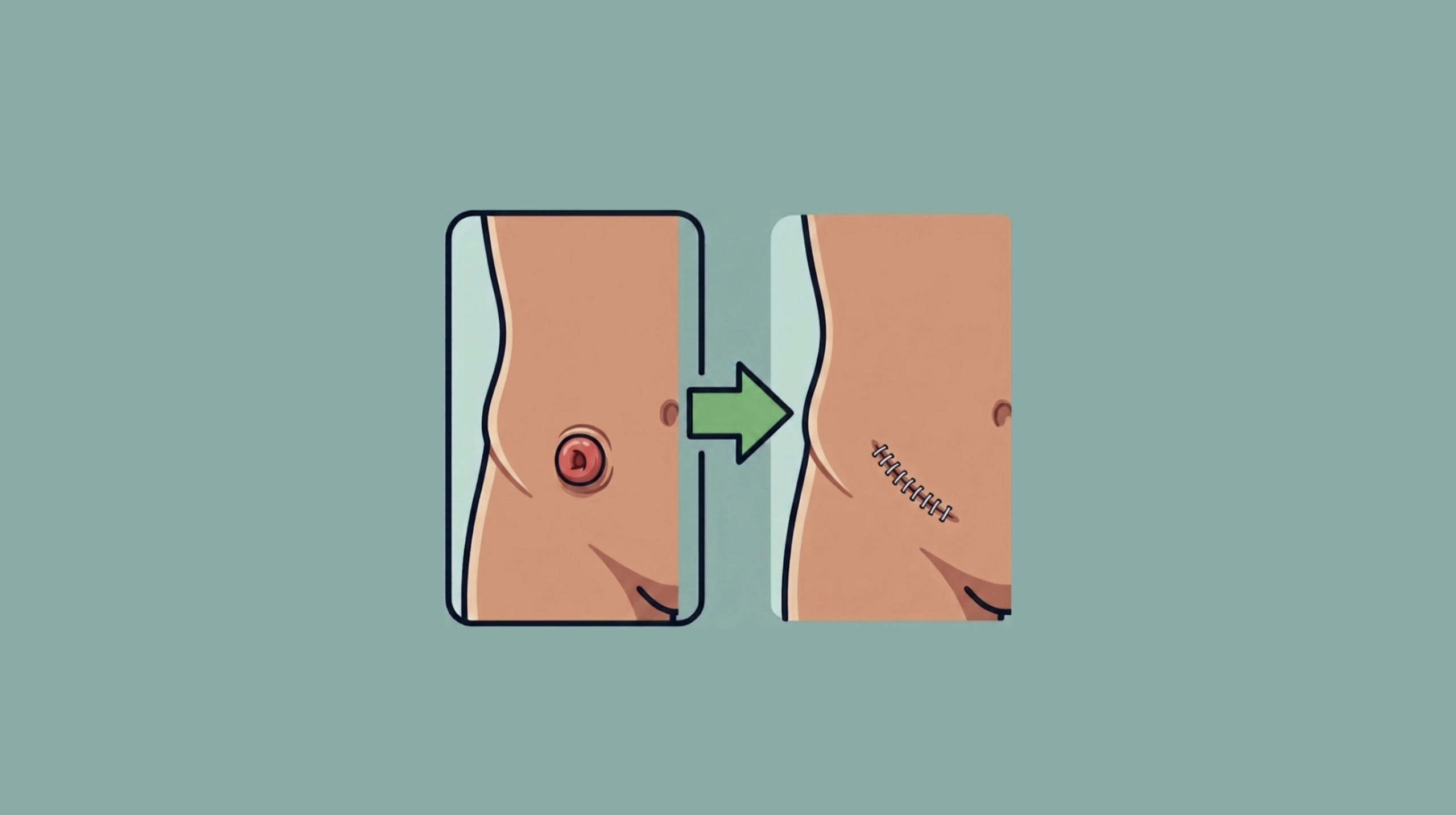
In the past, ileostomies were created and almost always left permanently with no plans for reversal. This has changed with the advancement of the medical field and ileostomies are now commonly reversed – a change that was noted around the mid-20th century.
Contraindications
- Active infection
- Malnutrition
- Severe cardiopulmonary disease
- Inability to tolerate anesthesia
Preoperative Considerations
- Usually occurs 3 months after creation, but has been shown to be safe performing as early as 3 weeks postoperative
- Contrast study (e.g., contrast enema or CT with rectal contrast) is often ordered 1 month after surgery to identify
- Anatomosis issues
- Length of colorectal stump
- Distal obstruction
- Ileal pouch integrity
Surgical Technique
- Peristomal skin incision made 1-2 mm from mucocutaneous junction and deepened into subcutaneous fat with sharp dissection to avoid injuring bowel wall. Dissection is carried down to the level of the anterior fascia and attachments to the fascia are divided circumferentially and the peritoneal cavity is entered. Any remaining attachments to the fascia are then removed to allow full mobilization of the bowel.
- If present, serosal or full-thickness injuries are repaired.
- Closure of loop ileostomy options
- Mobilize the small bowel and close in a transverse fashion using two-layer hand-sewn technique or with linear stapler
- Mobilize the small bowel. Side-to-side stapled anastomosis created with a linear cutting stapler inserted into the antimesenteric aspect of each limb. The remaining opening is closed with a linear stapler or using hand-sewn technique.
- Reduce bowel back into the abdominal cavity and close the fascia with interrupted one-absorbable figure-of-eight sutures. Skin is usually closed partially with absorbable purse-string suture and lightly packed with betadine-soaked gauze.
Postoperative Complications
- Ileus (13%)
- Small bowel obstruction (7%)
- Anastomotic leak (2%)
- Wound complications
- Purse-string skin closure partially approximates skin and allows the contaminated wound to heal by secondary intention