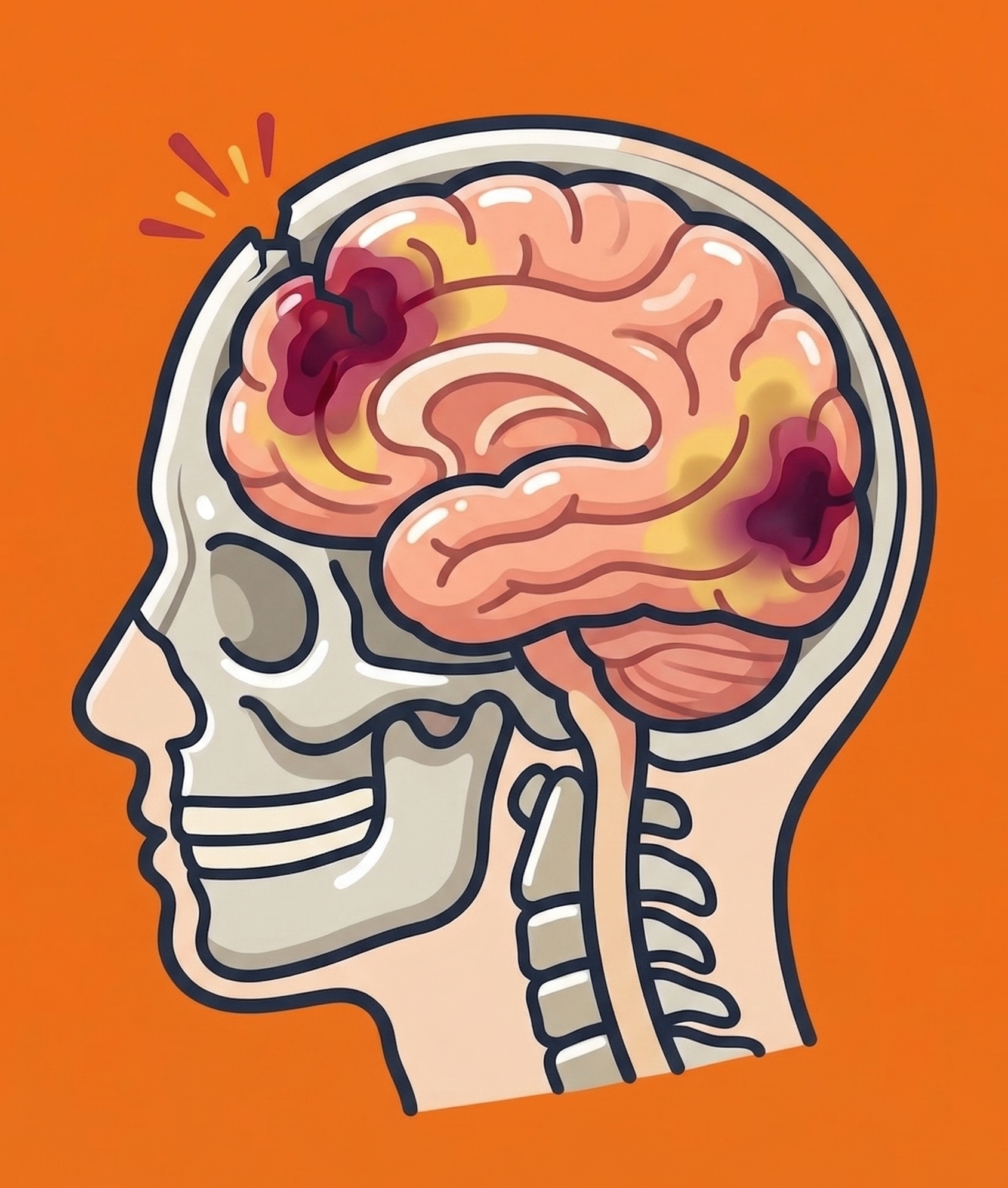
A traumatic brain injury (TBI) occurs when there is a transfer of kinetic energy into the brain followed by a drop in consciousness and awareness (GCS 3-8). A focal deficit as well as intracranial hematomas may or may not be present. TBI has been recognized throughout history and the diagnosis was formalized in the late 20th century – the Traumatic Brain Injury Act of 1996 was pivotal for aiding in the legal definition of TBI.
Etiology
- Immediate primary injury
- Neuronal
- Axonal
- Vascular
- Secondary injury → starts shortly after injury and continues for weeks after the traumatic event
- Cellular death
- Molecular dysfunctions
- Lipid peroxidation
- Excitotoxicity
- Disturbed autoregulation
- Blood-brain barrier disruption
- Brain edema
- Apoptosis
Pathogenesis
- 20% of cardiac output supplies metabolic needs of the brain at a rate of 50 mL cerebral blood flow/min
- Acute subdural hematoma or epidural hematoma or cytotoxic/vasogenic brain edema displaces CSF into general circulation and/or collapse the venous structures
- If critical measures of CSF and/or blood are displaced the rest of the structurees can’t be compressed and the intracranial pressure increases beyond 20 mmHg which may result in uncal or tonsillar herniation or drop in cerebral perfusion pressure leading to brain stem compression or ischemia
Presentation
- Confusion → obtunded → stupor
- Change in vital signs → Cushing triad
- Hypertension
- Bradycardia
- Irregular breathing
- Change in brain stem reflexes
- Abnormal pupillary reaction to light
- Loss of corneal reflexes
- Doll’s eyes
- No cough reflex
- No gag reflex
- Imaging: CT, CTA, and MRI are mainstay
Management
- Primary and secondary survey
- Airway, breathing, circulation
- Neurologic exam
- Level of consciousness
- Pupillary response
- Doll’s eye
- Corneal, cough, gag reflex
- CT head
- CTA indications
- GCS 9-15 WITH:
- Intracranial hematoma
- Contusion
- SAH
- Rules out vascular lesion
- GCS 9-15 WITH:
- GCS 3-8
- Intubate
- Ventilate
- Oxygenate
- CT head after resuscitation
- Mass lesions >30 mL → operating room
- Low GCS without mass lesion → ICP monitoring
- Intracranial pressure, cerebral perfusion pressure, and pressure reactivity index
- Intracranial pressure (ICP) monitoring
- Intraventricular cannula and external ventricular drainage device inserted within 4 hours of injury for patients who remains GCS 3-8 following trauma with a CT compatible with DAI and brain swelling
- Recommended in patients >40 years with CT scan demonstrating DAI type I
- Maximal medical management
- Euthermia
- Blood pressure support
- Sedation
- Moderate hyperventilation (PCO2 ~30 mmHg)
- Osmotherapy
- External ventricular drainage applied if ICP >22 mmHg
- Cerebral perfusion pressure
- Should be maintained around 60-70 mmHg
- ICP ~25 mmHg → consider decompressive craniectomy to prevent hypoxic ischemic injury
- Intracranial pressure (ICP) monitoring
- Craniotomy or decompressive craniectomies for hematomas or DAI
- Indication
- Failure of maximal medical management → prevent low-perfusion pressure and ischemia
- Indication
Relevant Information
- Diffuse axonal injury (DAI)
- CT
- Grade I DAI: open sulci, no shift, no effacement of basal cisterns
- Grade II DAI: small contusions/swelling, basal cisterns remain open
- Grade III DAI: small contusions/swelling, partial/complete obliteration of basal cisterns
- Grade IV DAI: significant shift of midline (>5 mm)
- MRI
- Grade I DAI: scattered lesions involving centrum semiovale
- Grade II DAI: lesions involving hemispheres and corpus callosum
- Grade III DAI: lesion involves hemispheres, corpus callosum, and brainstem
- Level of consciousness is proportional to injury severity
- CT
- Brain contusion
- Volume <30 mL → follow clinically w or wo ICP monitoring
- 90% mortality for civilian GSWs to the head