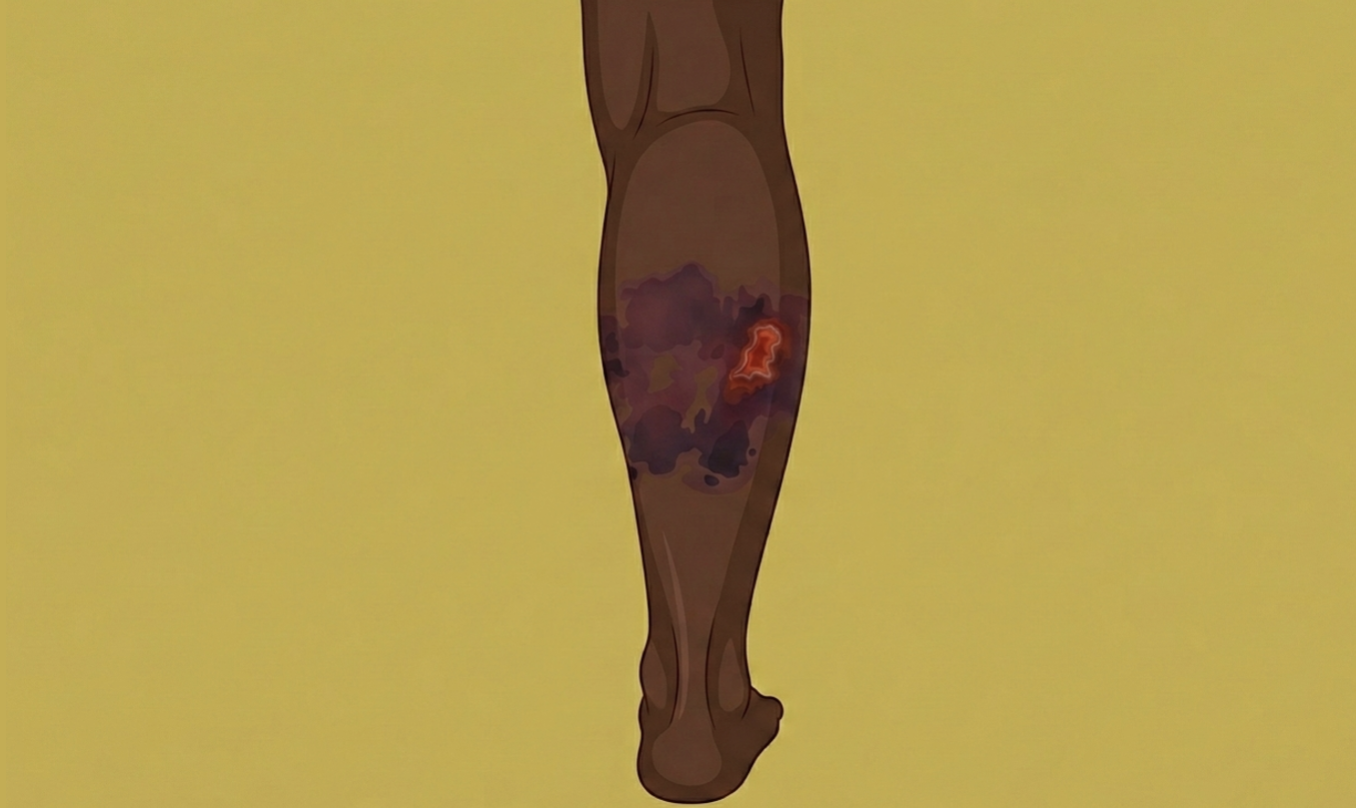
The term “sarcoma” is derived from Greek meaning “fleshy excrescence.” Rudolf Virchow worked to classify sarcomas as a distinct connective tissue cancer in the mid-19th century.
Pathogenesis
- Genetic mutations
- Oncogenes commonly seen in sarcomas: CDK4, N-myc, ras-related genes
- Synovial sarcomas: reciprocal translocation between SS18 and SSX genes
- Liposarcoma: amplification of MDM2 oncogene
- Myxoid liposarcoma: FUS-DDIT3
- Alveolar rhabdomyosarcoma: PAX3-FOXO1
- Desmoplastic small round cell tumors: EWS-WT1
Presentation
- Painless mass (growing months-years; may have pain secondary to mass effect if large enough)
- Sometimes will have trauma to the affect area
- Physical exam notes
- Firmness of mass
- Whether mass is tethered to surrounding structure or mobile
- Associated muscular weakness or nerve involvement
Workup
- Imaging
- MRI
- Imaging of choice
- T1, T2, STIR, and contrast provide details on diagnosis, tumor size, and extent of peritumoral edema (shown on STIR)
- XR are appropriate for bone tumors
- MRI
- Histology
- After imaging, histologic confirmation is needed with biopsy. Histology is the most important part in determining how a sarcoma will behave in the future (please note that Grade used to be the most important part).
- Completed using either ultrasound or CT guidance
- Approaches
- Core needle biopsy
- Procedure of choice for diagnosis of bony or soft tissue mass
- Fine-needle aspiration (FNA)
- Can be used but may not provide enough tissue for diagnosis
- Excisional biopsy
- Must plan incision with future surgical procedures in mind
- Incisions created along long axis of limb with ability to resect it during future surgeries
- Consider for tumors <3 cm
- Core needle biopsy
Staging
- Imaging of the entire area where the tumor is located
- Myxoid liposarcoma → CT A/P (common to metastasize to abdomen, retroperitoneum, axial spine)
- Epithelioid sarcoma, angiosarcoma, leiomyosarcoma → CT A/P
- Alveolar soft part sarcoma, angiosarcoma → MRI brain
- Consider ultrasound for histologies that are common to metastasize to lymph nodes
- Clear cell
- Angiosarcoma
- Rhabdomyosarcoma
- Epithelioid sarcoma
- Metastatic disease evaluation
- CT chest w or wo contrast
- Whole-body PET/CT is also an option
- CXR may be sufficient for tumors with low metastatic potential
- American Cancer Society: Stages of Soft Tissue Sarcomas
Treatment
- Three pillars → radiation, chemotherapy, surgery
- Radiation
- Radiation greatly improves local recurrence rate but doesn’t affect overall survival
- If adequate margins (2 cm) can be obtained, radiation can be omitted for high grade tumors ≤5 cm
- Comparing preoperative to postoperative radiation, there is no difference in local recurrence, but neoadjuvant therapy has double the rates of wound complications while adjuvant therapy leads to increased late affects which influences quality of life
- The Treatment of Soft-tissue Sarcomas of the Extremities by Rosenberg et al. (1982)
- Randomized Prospective Study of the Benefit of Adjuvant Radiation Therapy in the Treatment of Soft Tissue Sarcomas of the Extremity by Yang et al. (1998)
- Chemotherapy
- Indications
- High risk of metastatic disease
- High-grade tumors like leiomyosarcoma or dedifferentiated liposarcoma >5 cm in size
- Confirmed metastatic disease
- High risk of metastatic disease
- Neoadjuvant chemotherapy
- Shrink tumor allowing for easier surgical resection
- Early treatment of micrometastatic disease
- Indications
- Surgery
- Consider functional status of the patient
- Goals
- Circumferential margins of 1-2 cm of grossly normal tissue
- Place clips to guide radiation therapy
- Options
- Wide excision
- Multicompartmental resections
- Amputation
- Sentinel lymph node biopsy is considered for high-risk subtypes
- Notes
- Superficial fascia can be left if the tumor is superficial to fascia
- Rim of underlying muscle is taken if fascia is involved
- Periosteal stripping is done to elevate tumor and eliminate need for bony resection
Relevant Information
- Sarcoma by metastatic potential
- Low
- Atypical lipomatous tumor/well-differentiated liposarcoma
- Dermatofibrosarcoma protuberans (DFSP)
- Desmod tumor
- Intermediate
- Myxoid liposarcoma
- Myxofibrosarcoma
- Extraskeletal chondrosarcoma
- Solitary fibrous tumor (hemangiopericytoma)
- High
- Alveolar soft part sarcoma
- Angiosarcoma
- Clear cell sarcoma
- Dedifferentiated liposarcoma
- Epithelioid sarcoma
- Extraskeletal Ewing sarcoma
- Extraskeletal osteosarcoma
- Leiomyosarcoma
- Malignant peripheral nerve sheath tumor (MPNST)
- Neurogenic sarcoma (malignant schwannoma)
- Pleomorphic liposarcoma
- Rhabdomyosarcoma
- Synovial sarcoma
- Undifferentiated pleomorphic sarcoma
- Low
- Survival at five years is 65%
- Local recurrence is seen 10-20% of the time, most commonly in first 2 years after surgery
- Distant metastatic disease is seen 40-50% of patients with intermediate and high-grade tumors. Most common site of metastasis is lung, followed by liver, bone, and subcutaneous metastases.
Complications
- Infection
- Bleeding
- Hematoma
- Seroma formation
- Wound problems