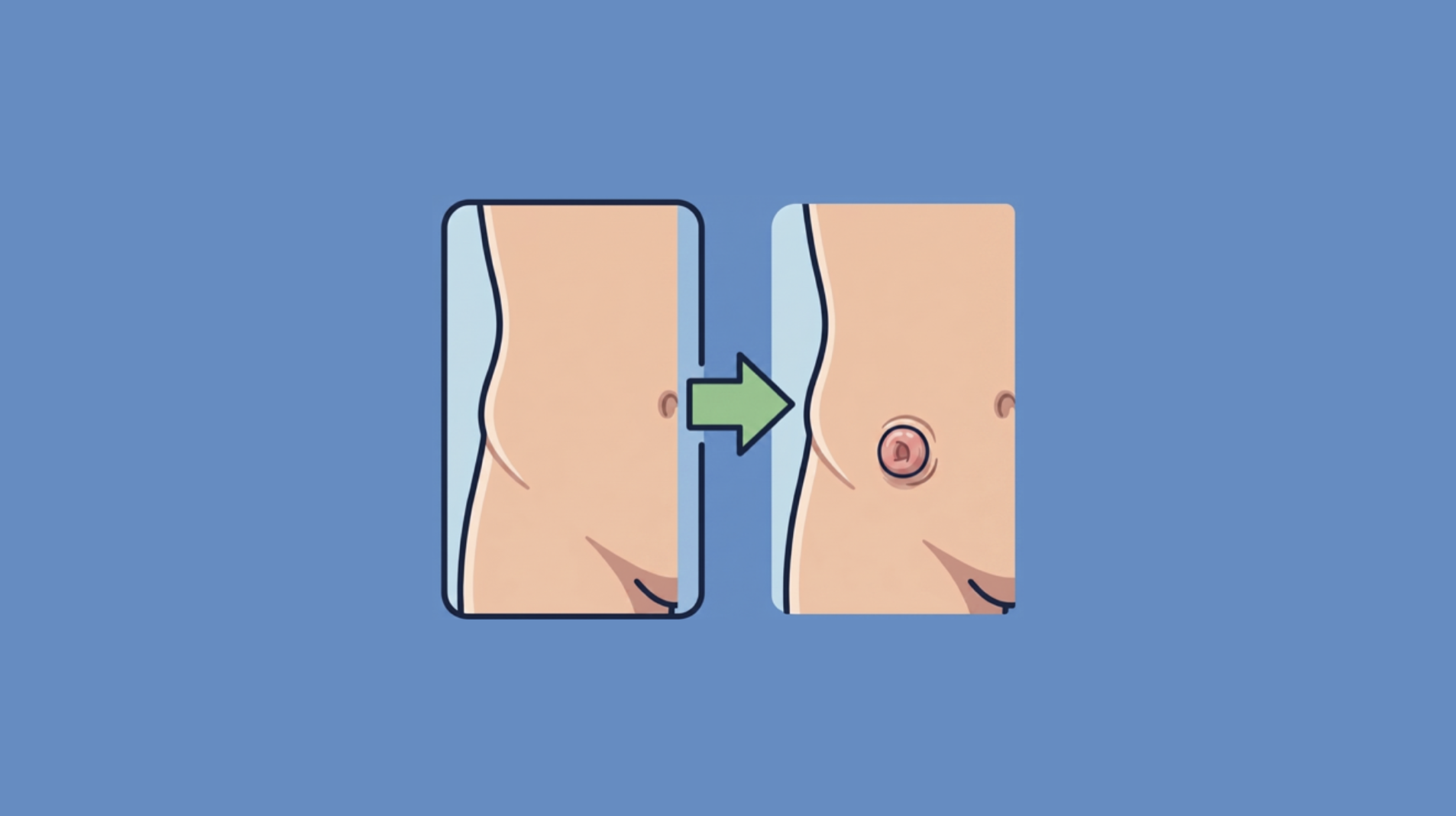
Ileostomy creation was first recorded after being performed by the German surgeon Wilhelm Baum in 1879. Bryan Brooke refined the stoma technique to spout and evert (fold back) the stoma in order to protect the skin and control ostomy drainage in 1952.
Indications
- End ileostomy → fecal diversion
- Often temporary
- Ischemia
- Perforation
- Severe colitis
- Lower GI hemorrhage
- Inflammatory bowel disease
- Infectious colitis
- Often permanent
- Ulcerative colitis
- Familial adenomatous polyposis with IPAA is contraindicated
- Crohn colitis with severe anorectal disease
- Severe fecal incontinence
- Often temporary
- Loop ileostomy → temporarily divert fecal stream and protect anastomosis
- Ileal-pouch anastomosis
- Ileorectal anastomosis
- Low colorectal or coloanal anastomosis
- Colorectal obstruction with competent ileocecal valve
- Diversion for near-obstructing colorectal mass
- Anastomotic leak
- Rectal or perineal trauma
- Fournier gangrene
- Severe fecal incontinence
- Radiation proctitis
- Pelvic sepsis
- Sacral decubitus ulcer
- Symptomatic rectovaginal fistula
- Sphincteroplasty
- Rectovaginal and rectourethral fistula repair
- Rectal mucosal advancement flap
Preoperative Considerations
- Patients should receive education prior to ostomy creation
- Ostomy location
- If possible, should occur with enterostomal therapy nurse that is certified by the Wound, Ostomy, and Continence Nurses Society (WOCN)
- Evaluate in sitting, standing, and bent forward positions
- Ostomy triangle
- Umbilicus
- Anterior superior iliac spine
- Pubic tubercle
- Place through rectus muscle to avoid prolapse
Risks
- Peristomal infection
- Skin complications
- Ostomy retraction
- Possible revision
Relevant Information
- Loop ileostomy is preferred over loop colostomy
- Lower infectious complications
- Lower prolapse rate
- Improved quality of life
- Loop ileostomy also has less odor
Surgical Technique
- End ileostomy
- Site for future ostomy location is marked and the skin is grasped with Kocher and elevated. 2-cm nickel-sized circular piece of skin is excised with scalpel and dissection is carried out with Bovie to amputate the disk of skin.
- Vertical incision is created in the subcutaneous fat and Richardson retractors are used to expose anterior rectus abdominus fascia. Cruciate or vertical incision is created on the fascia and the rectus abdominis muscle is exposed and a Kelly clamp is used to spread the rectus abdominis. Underlying posterior fascia and peritoneum are then incised and the resulting opening is dilated to allow for the passage of two fingers.
- Babcock is placed through the opening in the abdominal wall to grasp the cut end of the ileum and deliver it through the opening with care to ensure there is no injury. The ileum should protrude from the above the skin roughly 4 cm and orientation of the ileum should ensure there is no twisting.
- Midline incision is closed prior to stoma maturation. When maturing the stoma, the goal is for the ostomy to extend a minimum of 2 cm above the abdominal wall (Brooke ileostomy). Full-thickness 3-0 absorbable Vicryl sutures are placed in four quadrants through the distal end of the ileum incorporating mucosa and serosa followed by a bite of the dermis. Sutures are marked with hemostat until all four quadrant sutures are placed. When these sutures are tied down, the bowel will evert to form a 2-3 cm “nipple.” Additional sutures are then placed between each quadrant to close all of the gaps between the ostomy and the skin by attaching full-thickness edge of the ileum to the dermis layer of the skin.
- The ostomy appliance is then cut to allow the 1-2 mm margin.
- Loop ileostomy, open
- Site for future ostomy location is marked and the skin is grasped with Kocher and elevated. 2-cm nickel-sized circular piece of skin is excised with scalpel and dissection is carried out with Bovie to amputate the disk of skin.
- Vertical incision is created in the subcutaneous fat and Richardson retractors are used to expose anterior rectus abdominus fascia. Cruciate or vertical incision is created on the fascia and the rectus abdominis muscle is exposed and a Kelly clamp is used to spread the rectus abdominis. Underlying posterior fascia and peritoneum are then incised and the resulting opening is dilated to allow for the passage of two fingers.
- A mobile loop of ileum measuring 20-30 cm proximal to ileocecal valve or ileoal pouch is created and made sure to reach ileostomy site without tension. Orientation of the different limbs can be performed with different colored suture to ensure they maintain the orientation as desired. A Babcock is placed through the opening in the abdominal wall to grasp the ileum and deliver it through the opening with care to ensure there is no injury. Bowel should be oriented with proximal/afferent limb cephalad or rotated 90 degrees for it to be caudal.
- An avascular window is created in the mesentery at the midpoint of the loop and a tonsil clamp is used to pull a 12-Fr red rubber catheter through the mesenteric window which will serve as a supporting rod. The catheter is then cut to the appropriate length and the two ends are sutured to itself or anchored to skin with nonabsorbable suture.
- Abdominal incision is then closed and an enterotomy is made on the antimesenteric side of the bowel using Bovie electrocautery 2-3 cm distal to apex of the loop, within the efferent portion of the loop and extending within 2-3 mm on either side but not into the mesentery.
- Full-thickness 3-0 absorbable Vicryl sutures are placed in four quadrants through the ileum, followed by seromuscular bite just proximal to the skin, followed by a bite of the dermis. Sutures are marked with hemostat until all four quadrant sutures are placed. When these sutures are tied down, the bowel will evert and emphasize the proximal lumen while deemphasizing the distal lumen. Additional sutures are then placed between each quadrant to close all of the gaps between the ostomy and the skin by attaching full-thickness edge of the ileum to the dermis layer of the skin.
- The ostomy appliance is then cut to allow the 1-2 mm margin. Red rubber catheter should be removed 3-5 days after surgery to prevent creating an open wound or tract surrounding the ostomy.
- Loop ileostomy, laparoscopic
- Site for future ostomy location is marked.
- Abdomen is entered and trocars placed to assist with assessing anatomy. Cecum is visualized and traced to identify terminal ileum and fold of Treves. The ileum is evaluated and a mobile loop that is easy to pull up the marked ileostomy site is identified and marked to ensure orientation of the different limbs can be performed with different colored suture to ensure they maintain the orientation as desired.
- Site for future ostomy is grasped with Kocher and elevated. 2-cm nickel-sized circular piece of skin is excised with scalpel and dissection is carried out with Bovie to amputate the disk of skin. Vertical incision is created in the subcutaneous fat and Richardson retractors are used to expose anterior rectus abdominus fascia. Cruciate or vertical incision is created on the fascia and the rectus abdominis muscle is exposed and a Kelly clamp is used to spread the rectus abdominis. Underlying posterior fascia and peritoneum are then incised and the resulting opening is dilated to allow for the passage of two fingers.
- A 15 mm trocar (or balloon-tipped trocar) is placed through this opening to maintain pneumoperitoneum. A soft bowel grasper is used through this trocar to grab the loop of ileum. Trocar and ileal loop are then removed, allowing for gentle delivery of the ileum through the ostomy site. Bowel should be oriented with proximal/afferent limb cephalad or rotated 90 degrees for it to be caudal.
- An avascular window is created in the mesentery at the midpoint of the loop and a tonsil clamp is used to pull a 12-Fr red rubber catheter through the mesenteric window which will serve as a supporting rod. The catheter is then cut to the appropriate length and the two ends are sutured to itself or anchored to skin with nonabsorbable suture.
- Abdominal incision is then closed and an enterotomy is made on the antimesenteric side of the bowel using Bovie electrocautery 2-3 cm distal to apex of the loop, within the efferent portion of the loop and extending within 2-3 mm on either side but not into the mesentery.
- Full-thickness 3-0 absorbable Vicryl sutures are placed in four quadrants through the ileum, followed by seromuscular bite just proximal to the skin, followed by a bite of the dermis. Sutures are marked with hemostat until all four quadrant sutures are placed. When these sutures are tied down, the bowel will evert and emphasize the proximal lumen while deemphasizing the distal lumen. Additional sutures are then placed between each quadrant to close all of the gaps between the ostomy and the skin by attaching full-thickness edge of the ileum to the dermis layer of the skin.
- The ostomy appliance is then cut to allow the 1-2 mm margin. Red rubber catheter should be removed 3-5 days after surgery to prevent creating an open wound or tract surrounding the ostomy.
Postoperative Considerations
- ERAS® Society
- Initial ileostomy output can often be >1,000 mL/day, however this should slow down to ideally be under 1,000 mL/day → may require diet mofiedifeiation with fiber supplementation to decrease output and avoid dehydration
Postoperative Complications
- Early complications
- Ostomy necrosis
- Ostomy retraction
- Late complications
- Skin irritation
- Appliance fixation issues
- Peristomal leakage of ileal effluent
- Dehydration
- Renal failure
- Prolapse
- Bleeding
- Parastomal hernia
- Urinary stones
- Small bowel obstruction
Resources
- The American Society of Colon and Rectal Surgeons Clinical Practice Guidelines for Ostomy Surgery (2022)
- Intestinal Stomas: Indications, Management, and Complications (2012)