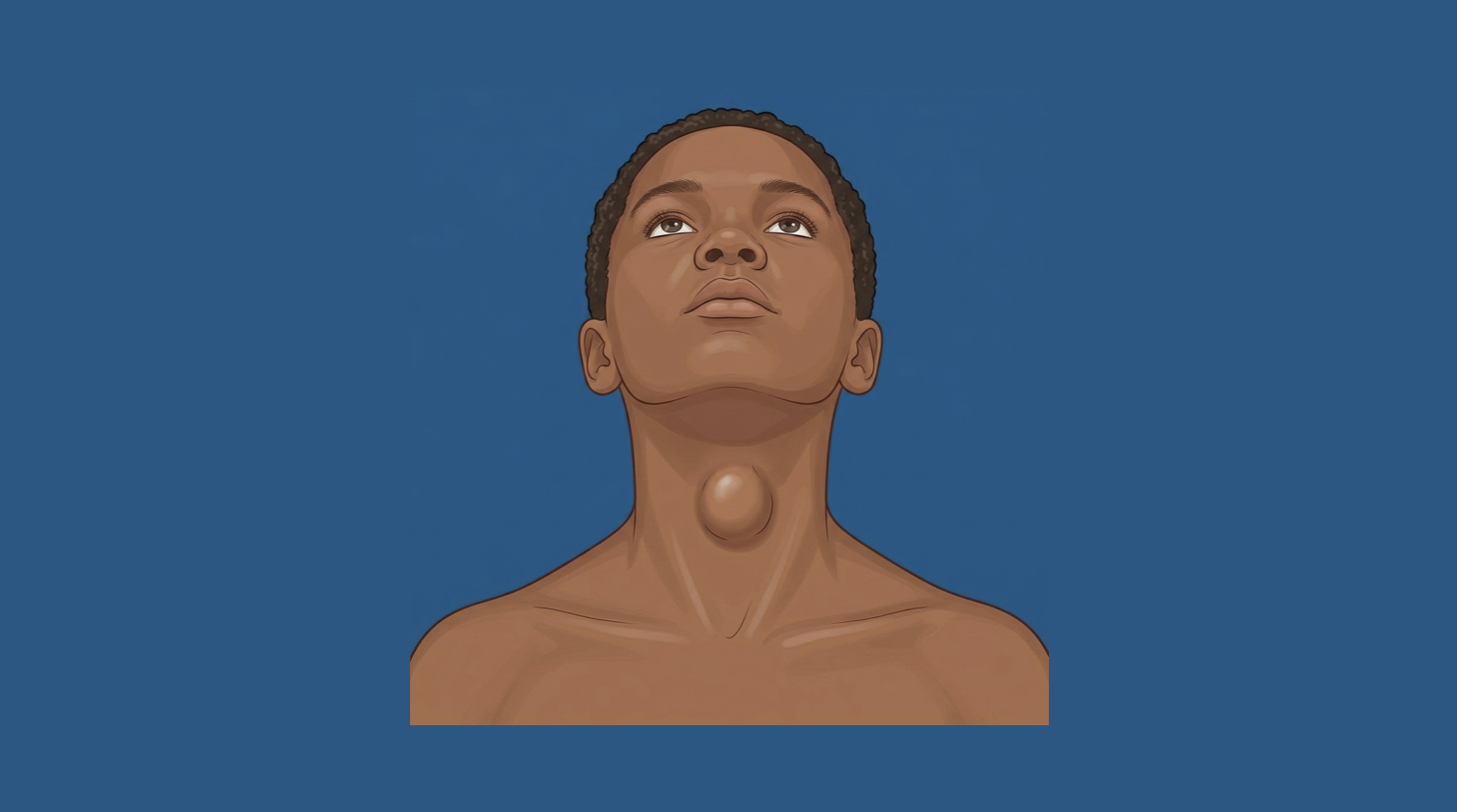
Thyroglossal duct cysts (TGDCs) are congenital anomalies that form as a result of developmental remnants. They are often diagnosed during early childhood. Multiple surgical procedures have existed to treat in the past. In 1893, Schlange first proposed excising the cyst along with a central portion of the hyoid bone. In the 1920s, Walter Sistrunk detailed a surgical procedure that included removing the central hyoid bone and tract, extending to the base of the tongue, in order to decrease recurrence rate – this procedure remains the gold standard.
Epidemiology
- Often diagnosed during childhood, by age 5
Pathogenesis
- Residual thyroglossal duct can get trapped within midpoint of hyoid bone or in close proximity anteriorly around seventh week gestation
- Can occur if any portion of thyroglossal duct persists after tenth week gestation
- May have squamous or pseudostratified ciliated columnar epithelium, as well as salivary or thyroid tissue in the walls
Presentation
- Painless midline neck mass that moves with swallowing
- Usually occurs within first two decades of life
- Location
- Thyrohyoidal region (66%)
- Suprahyoid region (26%)
- Suprasternal (5%)
- Intralingual (2%)
Workup
- History and physical
- Mass characteristics
- Timing of onset
- Development/enlargement
- Changes in size over time
- Location
- hard/soft mass
- Skin changes overlying mass
- History of trauma
- Exotic travel
- Systemic symptoms
- Mass characteristics
- Ultrasound
- Evaluate thyroid gland
- Evaluate thyroglossal duct cyst
- Round/oval, well-circumscribed lesion
- Internal anechoic features
- May appear pseudo-solid in children
- Posterior enhancement often present
- CT or MRI can be used if it is a complicated casse or clinical presentation is unusual
Treatment
- Infected → avoid complete excision as the tissue planes are distorted. In these instances, antibiotics with needle aspiration and I&D have been used until infection resolves.
- Surgical resection → Sistrunk procedure
- Indications
- Recurrent infections of cyst
- Significant enlargement of TGDC
- Unusual presentation/unsure diagnosis
- Avoid complete excision when cyst is acutely infected as the tissue planes are distorted. In these instances, needle aspiration and I&D have been used until infection resolves.
- Procedure
- Transverse cervical incision
- Mobilize and excise thyroglossal duct cyst and associated track – including tract extending to base of tongue
- Divide mylohyoid and hyoglossus muscle attachments to superior hyoid
- Excise central portion of hyoid bone, 1 cm from midline bilaterally
- Removal of hyoid bone
- Suture ligate the proximal tract
- Remove specimen en-bloc
- Indications
Differential Diagnoses
- Branchial cleft cyst
- Dermoid cyst
- Ectopic thyroid tissue
- Thymic cyst
- Thyroiditis
- Thyroid nodules
- Enlarged lymph node