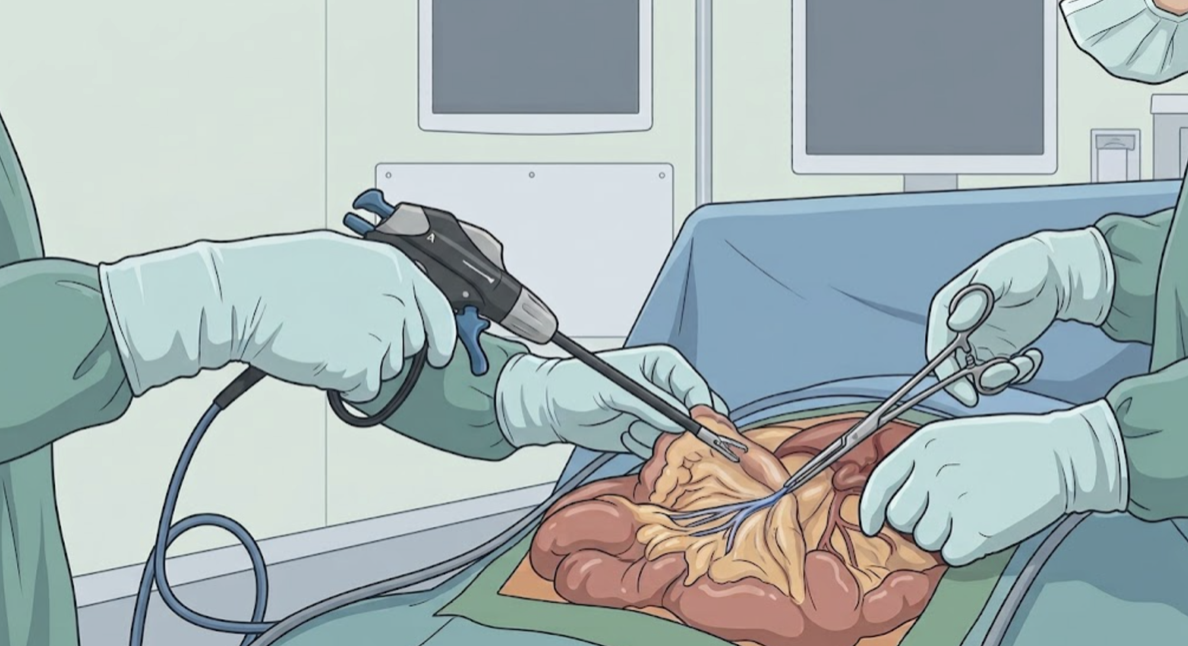
Surgical energy has revolutionized many aspects of surgery. The first commercial electrosurgical device is widely accepted to be created by Dr. William Bovie in 1920 after he discovered using high frequency alternating current could be used to incise coagulated tissue and achieve hemostasis. His creation was utilized by Dr. Harvey Cushing on October 1, 1926.
Types of Energy
- Monopolar radiofrequency energy (“Bovie”)
- Cut
- Low-voltage/high-current mode
- High current density by treating a small amount of tissue during activation
- Vaporizes cells by rapidly heating them to boiling point
- Heats tissues more evenly
- Can seal vessels by picking them up with forceps and touching the instrument with Bovie while activating cut mode
- Coag
- High-voltage/low-current
- Density is lower by increasing the area of tissue that has contact with the instrument
- Raises temperature of the tissue more slowly than “cut” mode which causes protein coagulation or dessication
- Superficial coagulation is achieved by holding instrument close to the tissue but not touching tissue directly which results in a black eschar due to breakdown of elements including carbon into atomic components
- Blend
- Combination of “cut” and “coag”
- Maximize energy effectiveness
- Creates safer, low-voltage mode
- Cut
- Bipolar radiofrequency energy
- Contains both limbs of electrical circuit in a single instrument
- Focuses energy on the tissue between the tips of the instrument
- Required voltage is reduced (100-200 V) compared to Bovie (1,400-9,000 V)
- Can consistently seal vessels ≤7 mm in diameter
- Ultrasonic energy
- Convert low-voltage radiofrequency energy into high-frequency (~44,000 Hz) mechanical vibrations via piezoelectric crystals in the device handle
- Vibrations make friction which heats tissue leading to protein denaturation (coagulation) as well as cutting tissue using temperatures below boiling
- Can seal vessels ≤3 mm in size and newer devices can seal ≤8 mm in size
- Plasma energy
- Short bursts of radiofrequency energy along edge of device
- Can result in cutting and coagulation of tissue with minimal thermal spread
- Thermal spread: 2-3 mm
- Lasers
- Beam of light is focused on tissue generating heat
- Utilized for cutting and coagulation
- Limited use due to cost, specialized training, and increased OR times
- Microwave and radiofrequency energy ablation
- Energy applied directly to tissue to cause necrosis either open or percutaneous
- Primary applications are in tumor necrosis or arrhythmia ablation
- Subtypes
- Bipolar
- Monopolar
- Internally cooled
Electrosurgical Injuries
- Fires
- 550-650 per year in the United States
- Educational material
- SAGES FUSE training
- Association of peri-Operative Registered Nurses (AORN)
- Emergency Care Research Institute (ECRI)
- US Council of Surgical and Perioperative Safety (CSPS)
- Anesthesia Patient Safety Foundation (APSF)
- Three elements are needed for fire to occur
- Heat and/or ignition source (aka surgical energy, patient or fluid warmer)
- Fuel including alcohol-based prep
- Oxygen
- Majority occur in airway or upper chest, head, and neck
- Management
- Stop flow of all airway gases – disconnect patient from breathing circuit including removing endotracheal tube during airway fire
- Remove burning or burned materials
- Extinguish fire from burning materials with saline, smothering it, or utilizing carbon dioxide fire extinguisher
- If not contained, utilize R.A.C.E.
- Rescue: attempt to rescue patient or staff
- Alert: Activate fire alarm and alert nearby staff
- Confine: isolate fire by closing doors, shutting off medical gas and electrical power
- Evacuate
- Prevention
- Educate on three elements needed for fire to occur
- Place drapes after alcohol-based prep has completely dried without pooling
- Enter airway with cold surgical instruments and patient on minimal oxygen
- Maintain fiber optic light in stand-by or “off” mode when not connected to the laparoscopic telescope
- Include fire risk assessment in preoperative timeout
- Antenna coupling
- Radiofrequency energy can be transmitted into the air such as through intact insulation and into nearby conductors such as cables, instruments, or monitoring electrodes
- Example: monopolar energy use with any wire/cable that lays close to Bovie cord will pick up stray energy and can burn the patient
- Prevention
- Separate active electrode and cords from nearby wires/cords
- Minimize voltage by decreasing power
- Avoid monopolar energy during single incision laparoscopic surgery
- Insulation failure
- Defects can be found up to 39% of monopolar instruments and is usually near the tip of the instrument as insulin gets thin and tapers
- Prevention
- Carefully inspect instrument before use for breaks in insulation
- Maximize visualization of entire instrument during activation to identify any failures
- Employ routine porosity detection of reusable laparoscopic instruments
- Residual heat
- Increased instrument temperature after use
- Most commonly seen with ultrasonic divides as they reach a higher temperature and remain hot longer than bipolar or monopolar
- Prevention
- Delay using ultrasonic devices to grasp until after 5 seconds have passed after using
- Direct application
- Unintentional activation of instrument when contacting tissue
- Prevention
- Protective “holsters” for devices that aren’t in use
- Activate devices when tip is visualized
- Understand activation cycle
- Interaction with electronic devices
- Transfer of energy from radiofrequency energy with nearby monitoring device cables
- Prevention
- Use low-power settings or low-energy devices
- Avoid energy devices near or parallel to implantable device current vector
- Direct coupling
- Using monopolar device to forceps or other conductor resulting in transfer of energy
- Prevention
- Avoid contact with other conductive instruments
- Maintain complete visualization of monopolar electrode
- Capacitive coupling
- Stored electric charge when two conductors are separated by an insulator
- Prevention
- Use low power setting
- Avoid using combined metal/plastic laparoscopic trocars
- Maintain complete visualization of instrument
Surgical Smoke
- Contains >150 chemicals that are toxic or carcinogenic
- Many viruses have ben found to be emitted through surgical smoke
- HPV
- Hepatitis
- SARS-COV-2