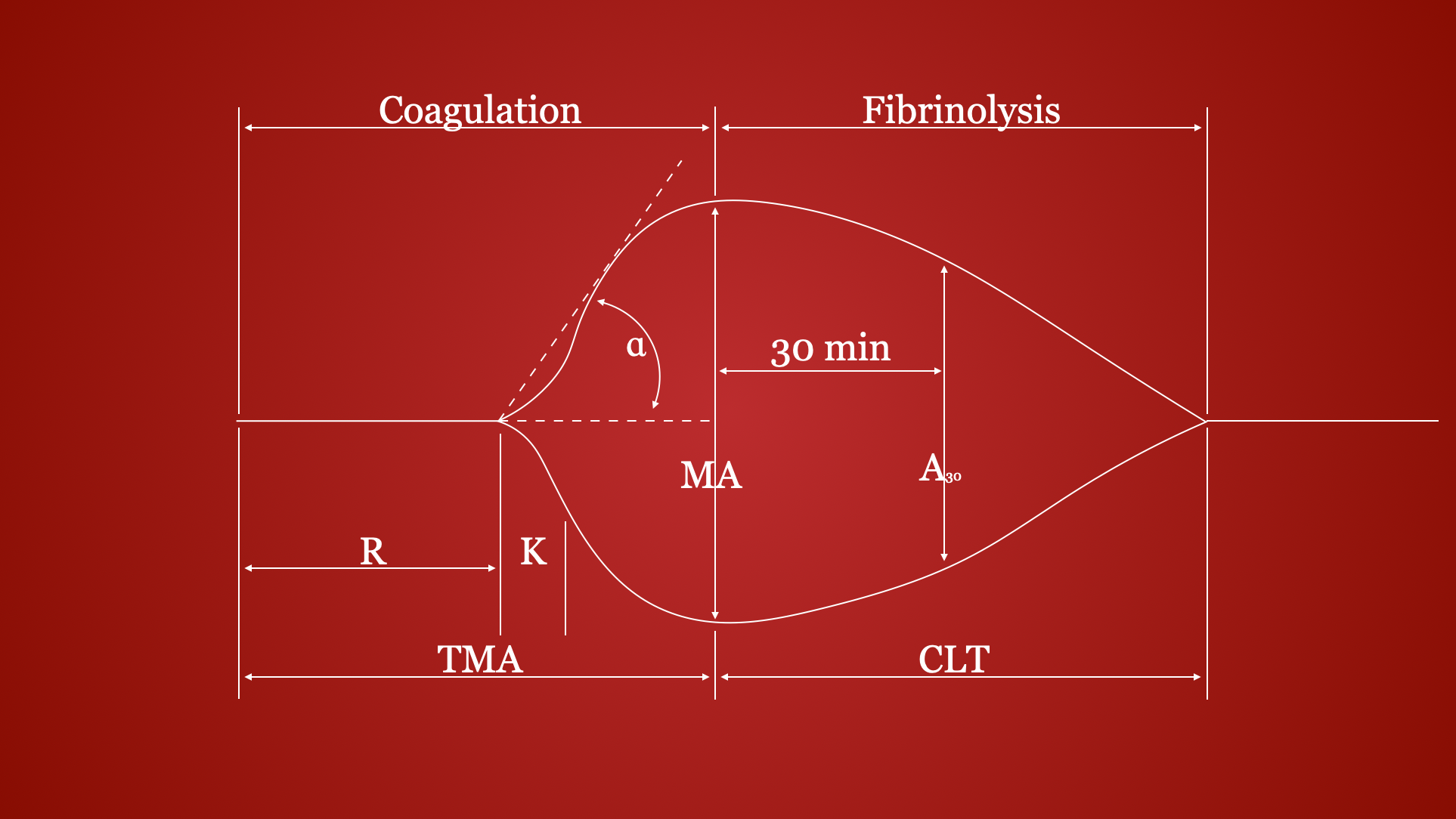
Thromboelastography (TEG) is a way of assessing the blood by measuring the global viscoelastic properties of whole blood clot formation under stress. It was created by Dr. Hellmut Hartert at the University of Heidelberg in Germany in 1948 as a way to measure whole blood coagulation profiles.
Test Basics
- Small cup of blood is activated and rotates around a pin, which forms a clot around the pin and parameters are measured
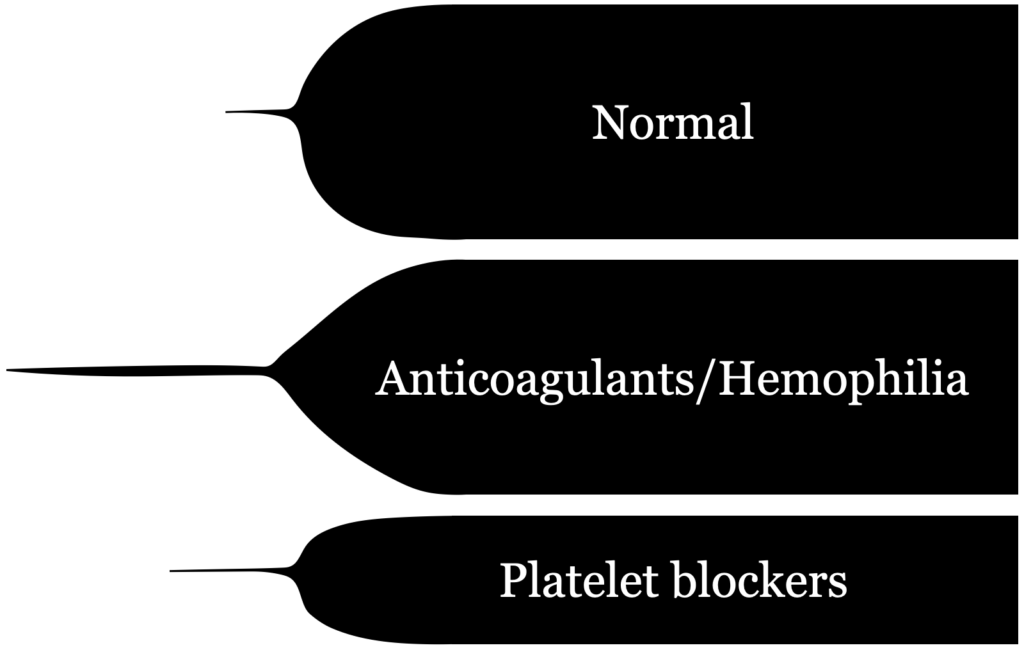
- Does not relatively measure effects of commonly used anticoagulants
- Used to guide massive transfusion as well as identify trauma-induced coagulopathy
Coagulation Phases
- Clot initiation
- Clot strength
- Clot stability
Components
- Reaction time (R-time) (s)
- Time required for first evidence of clot formation
- Dependent on clotting factors
- Normal: 4-8 minutes
- Prolonged → FFP
- Kinetics time (K-time) (s)
- Time required to form 20 mm of clot
- Represents fibrin cross-linking that propagates clot enlargement
- Dependent on fibrinogen
- Normal: 1-4 minutes
- Prolonged → cryoprecipitate
- ɑ-angle
- Rate/speed of clot enlargement
- Represents thrombin generation
- Measured tangent to curve of TEG tracing as K-time is reached
- Dependent on fibrinogen
- Normal: 47-74º
- Low → cryoprecipitate
- Maximum amplitude (MA) (mm)
- Point of maximal clot strength
- Represents both fibrin (20%) and platelet (80%) contribution
- Widest part of TEG
- Normal: 55-73 mm
- Decreased MA → administer platelets/ DDAVP
- LY-30
- Degree of fibrinolysis at 30 minutes
- Represents fibrinolysis
- Normal: 0-8%
- High → tranexamic acid or aminocaproic acid
Limitations
- Long testing times (at least 40 minutes)
- Need for testing at 37ºC
Resources
- Life in the Fast Lane: TEG
- Viscoelastic Hemostatic Assays: Moving from the Laboratory to the Site of Care – A Review of Established and Emerging Technologies (2020)
- AAST: Review of Thromboelastography
- SAGE Journals: Hellmut Hartert (1918-1993)